Wildlife · Nasalis larvatus · Endemic to Borneo
Proboscis monkeys: evolution's least subtle experiment.
A pot belly full of fermenting leaves, partially webbed feet, honking calls, and a nose that can hang past the chin — the proboscis monkey looks like a committee designed it, and every feature turns out to be load-bearing. Found nowhere on Earth but Borneo, it's the guaranteed-tier star of the Sandakan circuit. The only real question is how you want to meet it: point-blank at Labuk Bay's feeding platforms, or wild from a Kinabatangan boat at dusk. Here's the animal, then the honest comparison.
Updated August 2026 · Labuk Bay fees and feeding times checked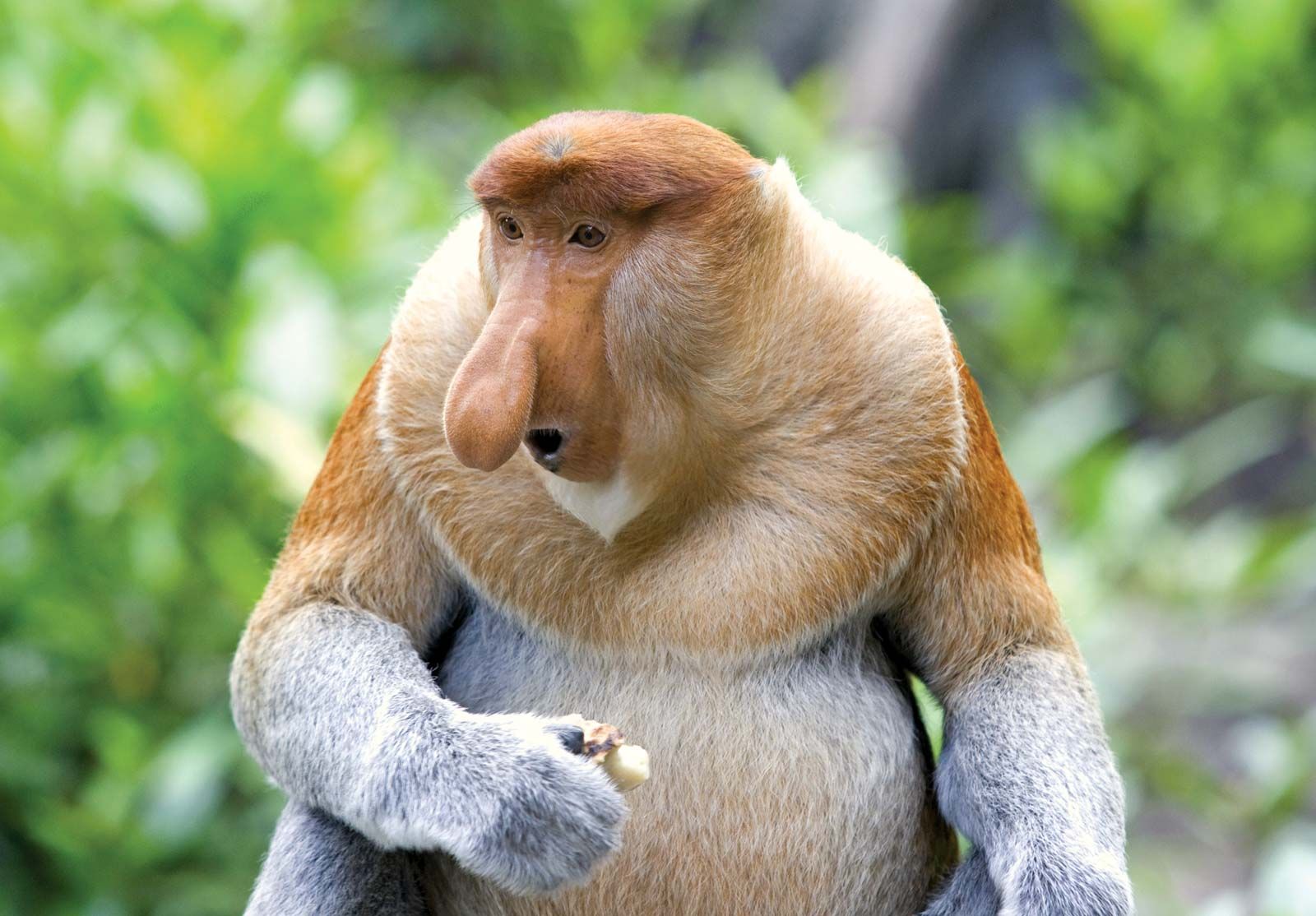
The animal
Every ridiculous feature, explained
The nose — biggest of any primate — belongs to the males, works as a resonating chamber that deepens and carries their honking calls, and functions as honest advertising: bigger noses track with bigger harems. The belly is a multi-chambered fermentation vat, closer to a cow's stomach than to yours, digesting the mature leaves and unripe fruit most primates can't touch — which is also why they permanently look like they've had an enormous lunch. They have.
The feet are partially webbed, because these are arguably the best swimmers among the world's monkeys: they cross rivers doing a competent front crawl, leap from riverside branches with a comedic lack of grace and an enormous splash, and the webbing helps them outpace the crocodiles that consider them a food group. The social system is harems — one male, his females and young — plus bachelor groups of hopefuls, and every evening all of them commute to the riverbank to sleep in the trees above the water, which is precisely why boat cruises find them so reliably.
Locals long ago nicknamed them monyet belanda — "Dutch monkey" — a colonial-era joke about sunburnt noses and bellies that the Dutch, to their credit, never managed to suppress. The species is no joke conservation-wise: endemic to Borneo's coastal and riverine forests, listed as Endangered, and losing habitat to the same conversion pressures as everything else on this coast.
Option one
Labuk Bay: point-blank, by arrangement
Labuk Bay Proboscis Monkey Sanctuary is a private reserve inside an oil palm estate about half an hour from Sepilok: a plantation owner found monkeys living in his mangrove pocket in the 1990s and chose to keep the forest and feed them instead of clearing it. A couple of hundred proboscis monkeys now range the sanctuary's mangrove patches, topping up at scheduled platform feedings of sugar-free pancakes and cucumber — supplementary rations, because the fragmented habitat can't fully feed them.
For visitors the arithmetic is simple: four feedings a day across two platforms, monkeys at arm's-reach distance, no telephoto lens required, silvered langurs and oriental pied hornbills freeloading alongside. It is the closest you will ever be to this species, and the easiest photography on the circuit.
The honest framing: Labuk Bay is habituated-wild viewing in a rescued fragment, not untouched nature — the plantation is visible from the boardwalk, which is rather the point. It's a genuine refuge doing real good in a compromised landscape, and it's candid about the trade it makes: proximity for wildness.
Option two
The Kinabatangan: wild, at boat's length
On the river there's no schedule and no pancakes — and it barely matters, because proboscis monkeys are the nearest thing to a certainty on any cruise. Every evening, harems commute to the riverside trees to sleep over the water; every dusk cruise drifts beneath them; every dawn cruise catches them waking, bickering, and launching themselves between trees with that trademark crashing abandon. Expect multiple groups per outing, at natural distance, behaving as if you weren't there — because, engine off, you effectively aren't.
What you trade for the wildness is the close-up: river monkeys are a binoculars-and-zoom experience, not an arm's-length one. What you gain is everything else the boat passes on the way.
The comparison
Labuk Bay vs the river, settled honestly
The resolution most visitors land on: if you're doing the Kinabatangan circuit, the river's proboscis viewing is complete in itself and Labuk Bay is optional. If you're Sepilok-only with a spare half day — or you need the close-up — Labuk Bay is a worthy add-on rather than a rival. Doing both is doubling up on the same species, pleasantly.
Proboscis FAQ
The recurring questions
Why do they jump into the water like that?
Partly commuting — the shortest line between feeding and sleeping trees sometimes crosses water — and partly predator maths: a fast, chaotic plunge-and-swim is harder for a crocodile to ambush than a tidy entry. The webbed feet and strong swimming make it a calculated risk rather than comedy, though from a boat it remains, frankly, comedy.
Do only males have the big nose?
The pendulous, past-the-chin version is male-only equipment; females and juveniles carry a smaller upturned nose. The male's grows with age and status, amplifies his honks, and signals his quality to females — one of nature's least deniable examples of ornament evolution.
When is the best viewing on the river?
The dusk cruise, categorically: harems settle into the riverside sleeping trees from late afternoon and are at their most visible and social. Dawn catches the same trees emptying. Midday, like every sensible mammal here, they're deep in shade doing nothing observable.
Is feeding them at Labuk Bay ethical?
It's a genuine debate with a local answer: the sanctuary's habitat fragment can't fully support its population, so supplementary feeding is welfare provision, not entertainment bait — closer to a food bank than a circus. Our ethics page gives the framework; Labuk Bay sits in the defensible-with-caveats category, and is unusually honest about its own compromises.