Wildlife · Birds · Kinabatangan & the Rainforest Discovery Centre
The hornbills of Sabah: all eight, honestly rated.
Borneo hosts eight hornbill species, and the Sandakan circuit — river, Sepilok's forest, the RDC canopy — is one of the easiest places on Earth to work through the list. Some cross your bow daily. Some need luck and a good guide. One is being poached toward oblivion for the "ivory" in its skull and you should not expect to see it, which is exactly why it leads the conservation section. Here's each bird, where it lives on the circuit, and your honest odds.
Updated August 2026 · odds are field judgement across a standard 3–4 day circuit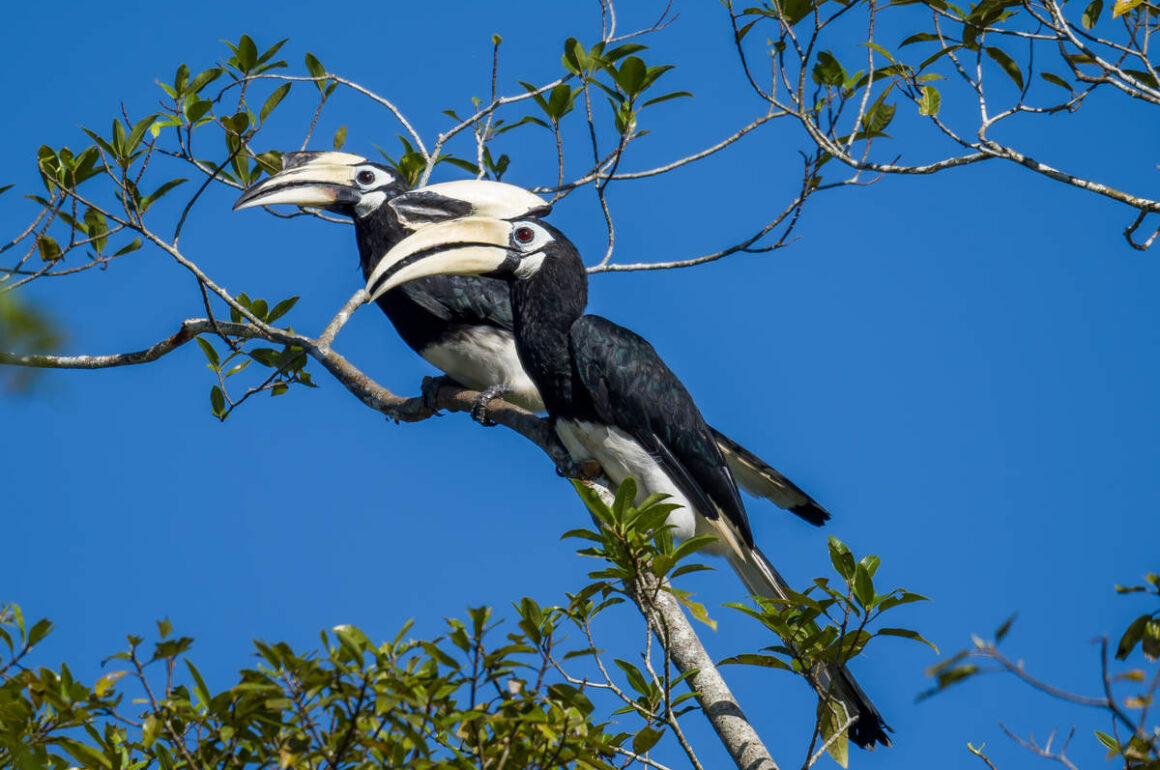
The family business
Big bills, sealed nests, and a sound you'll never mistake
Hornbills are the great fruit-couriers of Asian forests — fig specialists whose ranges spread the seeds that rebuild canopy, which is why ecologists call them forest farmers and why their decline is everyone's problem. The casque, that helmet along the upper bill, is mostly lightweight keratin scaffolding: an amplifier, a status ornament, and in one tragic case, solid.
Their breeding is the strangest in birddom: the female seals herself into a tree cavity with mud and droppings, leaving a letterbox slit, and moults flightless while the male provisions the whole family through the gap for months. A male hornbill crossing the river with a full gullet is often quite literally posting dinner. And the sound — a whooshing beat on every wingstroke, produced by air rushing through wing gaps — carries so far that guides call the birds before anyone sees them.
The checklist
Eight species, rated for the circuit
Oriental pied hornbill
The everyday hornbill: smallest, most sociable, happiest at forest edge — which the river corridor is, wall to wall. Flocks along the Kinabatangan, regulars at Labuk Bay's platforms, common around Sepilok. Your first hornbill, and probably your fiftieth.
Rhinoceros hornbill
The icon — jet body, upswept scarlet-and-gold casque, Sarawak's state emblem and everyone's screensaver. Pairs cross the river most days and the RDC canopy walkway meets them at eye level, which is the single best hornbill experience on the circuit.
Black hornbill
Compact, coal-dark, with a voice like machinery in distress. A lowland and riverine specialist that's genuinely common along the Kinabatangan once your guide tunes your ear to the racket.
Bushy-crested hornbill
The gang bird: travels in noisy family mobs that occupy a tree, argue about it, and leave together. Regular around Sepilok's forest and the RDC; on the river, heard as often as seen.
Wrinkled hornbill
A riverine and swamp-forest specialist with a corrugated yellow casque — scarcer rangewide than most of the list, but the lower Kinabatangan is exactly its habitat, and multi-cruise stays have fair odds.
Wreathed hornbill
Big, far-ranging, with a bark like a dog in the canopy and ridged "wreaths" along the bill. Covers huge distances tracking fruit, so it's a flyover bird: unmistakable when it happens, unschedulable until it does.
White-crowned hornbill
The punk of the family — spiked white crest, long white tail, and a habit of hunting low in dense tangle rather than parading the canopy. Present along the river, heard giving its soft hooting far more often than seen. A guide's-pride sighting.
Helmeted hornbill
The heartbreaker. Huge, ancient-looking, with a maniacal accelerating call that ends in cackling laughter — and a solid casque of "hornbill ivory" that carves like the elephant kind, which is why poaching has driven it to Critically Endangered. Survives in tall primary forest (Danum-type country, not the corridor). On this circuit, treat any encounter as a once-in-decades gift.
Where to actually stand: the RDC canopy walkway at dawn for eye-level rhinoceros and pied; the river cruises for volume and the riverine specialists; and any fruiting fig anywhere, which functions as a hornbill bus stop while it lasts.
The hard part
Red ivory: why the helmeted hornbill is vanishing
The helmeted hornbill's casque is solid keratin — dense enough to carve, prized for centuries as "hornbill ivory," and since the 2010s the target of an organised poaching trade that has emptied it from forest after forest across its range. It was uplisted to Critically Endangered as the scale became clear. The birds' own biology conspires against them: they're loud, faithful to fruiting trees, and slow to breed — a species built for stable old forest meeting a trade built for speed.
What a visitor can actually do is unglamorous and real: never buy carved casque or "hornbill ivory" anywhere in Asia (it's often mislabelled as elephant ivory or antique), and spend wildlife money where standing tall forest earns more than felled — which is the same answer this site keeps arriving at, because it keeps being the answer.
Hornbill FAQ
The recurring questions
Can I really see all eight in one trip?
Realistically no — a standard circuit reliably delivers three to five, a dedicated birding week with dawn discipline can push six or seven, and the helmeted hornbill lives outside the corridor's habitat entirely. Treat the checklist as a menu, not a promise; our honest odds page explains the house philosophy.
What's the best single spot for hornbills?
The RDC canopy walkway at first light: you're standing at the birds' altitude, the towers overlook fruiting crowns, and rhinoceros hornbills at eye level beat any river flyover. Pair it with dusk cruises and you've covered both of the family's rush hours.
Why do hornbills matter beyond being spectacular?
They're the forest's long-haul seed dispersers — big enough to swallow large figs whole and range widely, replanting canopy trees as they go. Lose the hornbills and the forest slowly loses its farmers; which is why their presence over the Kinabatangan is not just scenery but a working part of the corridor's recovery.